Wednesday, April 4, 2012

Easter Egg Dyeing

On Wednesday, March 28, Loyola Intensive English Program (LIEP) students spent an hour dyeing Easter eggs!


Below we see eggs in preparation.
James Zhang of China dyes an egg.
CoCo Zhao of China dyes an egg.
An orange egg with yellow lettering 
An egg with a face
The dyed eggs are displayed for all to see.
Eggs are set out to dry.
We arrange our egg display.
Eggs to admire!
And now we show off our individual eggs!
CoCo Zhao of China has won a chocolate Easter bunny for the best egg!
Each of us has an egg to show off!

Dear World at Loyola

Several Loyola Intensive English Program (LIEP) students participated in the "Dear World at Loyola"  body art project on Wednesday, March 21. This project is the creation of Robert X. Fogarty, who photographs people with a message for the world written on parts of their body, usually their arms and hands. Fogarty publishes these messages at his "Dear World" website.


Below are Fogarty's photos of LIEP students, displaying their messages for the world.


Fahad Almutairi of Kuwait

Inajara Da Costa Nunes of Brazil

Alhousseyni Gallo of Senegal

Ying Liao of China

Alicia Lucidi of France

Ahn Nguyen of Vietnam

Helena Posada of Nicaragua

Nicole Rios of Nicaragua

Serena Wang of China

A very special CONGRATULATIONS to Serena Wang, who spoke about her experience as a traveler and student in the United States at a Dear World gathering for members of the Loyola University New Orleans community on Thursday evening, March 24.

A big THANK YOU to Serena Wang for speaking so movingly of her experience, to all the LIEP students who participated in the Dear World project, to LIEP Instructor Christina Indovina for arranging LIEP's participation, and to Robert X. Fogarty for his creative artistry.


Saint Joseph's Day

Monday, March 19 was Saint Joseph's Day, a very important day for people of Sicilian descent in New Orleans. Many years ago, Sicily suffered from a severe drought and famine. Sicilians prayed to their patron, Saint Joseph, and finally the long-awaited rain came to bring life to the crops and relief to the people. In gratitude to Saint Joseph, Siciians prepared an altar to honor their patron saint and to display the bountiful harvest, of which they distributed a large share to the poor and needy. This became an annual tradition, which was brought to the United States with Sicilian immigrants.

Today, Sicilian Americans in New Orleans prepare colorful altars with statues, holy pictures, candles, and elaborately decorated breads, pastries, and other foods. Some families open their homes for people to view their altars, pray, honor Saint Joseph, receive something to eat, and perhaps make a donation for the poor.

Loyola Intensive English Program (LIEP) students and instructors visited two Saint Joseph altars in homes in uptown New Orleans, where we received a warm welcome, heard the story of Saint Joseph and the Sicilian famine, and admired the beautiful altar. We each received a bag containing a Saint Joseph prayer card, some Italian cookies, and a fava bean. We learned that the fava bean, usually used as food for cattle, was the only plant that grew during the famine and kept the people alive. Today it is considered a lucky bean, and whoever carries it will have good luck.

Below are photos from our visit to the Saint Joseph altars.

The Italian flag marks a home where a Saint Joseph altar is displayed
View of a Saint Joseph altar in an uptown New Orleans home
Another view of a Saint Joseph altar in an uptown New Orleans home
Nicole Rios of Nicaragua holds the gift bag she received with a Saint Joseph prayer card,
several Italian cookies, and a lucky fava bean.
Upon our return, LIEP Instructor Christina Indovina had an additional treat for us. She had assembled  all the ingredients for us to learn to make the traditional Italian fig cookies called cuccidati. Below are photos of our cuccidati making.
Ying Liao of China, Felix Garmendia of Venezuela, and LIEP Instructor Christina Indovina
mix ingredients.
The dough is rolled out, eventually to form a rectangle.
The fig stuffing is added and rolled up in the dough.
The cuccidati are carefully cut.
Alicia Lucidi of France prepares to take a baking sheet of cuccidati to the oven.
Alhousseyni Gallo of Senegal waits for the cuccidati to bake.
The cuccidati are ready to eat!
CoCo Zhao of China enjoys one of our just-baked cuccidati!

Friday, February 10, 2012

VISIT TO MARDI GRAS WORLD

Mardi Gras is just around the corner - on Tuesday, February 21 this year. Last week the students in the  Loyola Intensive English Program (LIEP) visited Blaine Kern's Mardi Gras World, the den where floats are assembled and decorated for many of the carnival parades.


Our visit began with a film on the history of Mardi Gras.
LIEP students are ready to view a film on Mardi Gras history.
After the film, King Cake was served.
Our guide serves us King Cake.
Olena Kashirny of Ukraine and Irma Chavez of Venezuela enjoy King Cake together.
After the film and King Cake, we entered the den, a huge warehouse-like area filled with floats and props. The props are large figures of fiberglass or papier-mache which can be installed on different floats from year to year. Below you will see some of the props and floats in Blaine Kern's Mardi Gras World den.
A long view of one section of the den, filled with props
Flowers for a float
Pol Salvador and Victor Messa of Spain watch as artists install flowers on a float.
Xiang "James" Zhang of China poses with a train float.
A mermaid prop
Helena Posada and Nicole Rios of Nicaragua pose with a Mr. Potato Head prop.
Cuicui "Coco" Zhao of China poses with a prop.
.
Cuicui "Coco" Zhao and Xuan "Serena" Wang pose with a pelican prop.
We concluded our visit to Mardi Gras World with some time in the gift shop, where we were able to try on various Mardi Gras accessories.
Helena Posada and Nicole Rios of Nicaragua and Marietta Rivero of Mexico
model Mardi Gras headpieces.
Cuicui "Coco" Zhao of China, Luiza Azevado of Brazil, and Xuan "Serena" Wang of China
show off their alligator hats.
Hao "Kevin" Li of China poses in a Mardi Gras costume.
Finally, we gather to say goodbye to Mardi Gras World.
LIEP students pose for a final photo before saying goodbye to Mardi Gras World.
Our visit to Blaine Kern's Mardi Gras World was fun and informative. Seeing where and how the floats and their props are created and assembled will increase our enjoyment during the carnival parades that begin this weekend, continue throughout next week, and culminate on Tuesday, February 21, with Mardi Gras itself!


Wednesday, January 18, 2012

ZEITOUN Van Tour

On Friday, November 18, the reading classes of the Loyola Intensive English  Program (LIEP) boarded the Loyola van for a tour of New Orleans sites that are important in the book ZEITOUN by Dave Eggers. The LIEP classes had read and discussed this book about the experience of the Zeitoun family during and after Hurricane Katrina. Below is a short summary of the book ZEITOUN, followed by an account of our van tour.


ZEITOUN by Dave Eggers
Mr. Abdulrahman Zeitoun, called Zeitoun by most people who know him, comes from Syria. He and his U.S. American wife, Kathy, own and run a house painting business in New Orleans. The Zeitoun family practices Islam.


As Hurricane Katrina was approaching New Orleans, Kathy and the Zeitoun children evacuated to Baton Rouge, while Zeitoun remained in New Orleans to oversee his home, his rental properties, and the properties of his clients. After the hurricane, Zeitoun found a working telephone line and called Kathy faithfully every day at noon. Zeitoun also owned a canoe and used it daily to rescue people trapped in their houses.


However, about a week after the hurricane, Zeitoun had the misfortune to be arrested for "looking suspicious." As a Hurricane Katrina arrestee without proper processing, he fell into "a black hole" in the prison system. The only thing that Kathy and the Zeitoun children knew was that Zeitoun's daily noon-time telephone calls suddenly stopped.


The book ZEITOUN had gripped us so strongly that we wanted to visit the sites that were important in Zeitoun's Hurricane Katrina experience. Our van tour included the following sites.

  • RESCUES AND PHONE CALLS: In our van, we followed Zeitoun's canoe route so that we could actually see the places where Zeitoun had stopped to rescue people and to make his daily telephone calls to his family.
  • THE CLAIBORNE / POYDRAS OVERPASS: We drove over the Claiborne / Poydras overpass, where Zeitoun had met and spoken with survivors who were waiting, unsheltered in the sun, for buses to take them out of the city. Many dogs were also on this overpass. Zeitoun had returned later in his canoe to find that all the people had been taken away and that all the dogs had been shot.
  • STAGING AREA: We drove past the staging area where official boats had been sent out each day to find and rescue people on roof-tops and where Zeitoun had been taken after his arrest to be transported to a temporary jail.
  • CAMP GREYHOUND: This was perhaps the most impressive site on our van tour. We stopped to visit the New Orleans Union Passenger Terminal, where Amtrak trains and Greyhound buses arrive and depart. Called Camp Greyhound in the weeks after Hurricane Katrina, this terminal had been transformed into a temporary jail for anyone arrested in the post-hurricane chaos. Arrestees like Zeitoun had been placed into outdoor cages to await transportation to larger prisons.

The photo below shows Camp Greyhound in the weeks after Hurricane Katrina.
Camp Greyhound in the weeks after Hurricane Katrina
The New Orleans Union Passenger Terminal has an amazing four-wall mural depicting scenes from the history of New Orleans. Newly arrested and frightened, Zeitoun had been struck by the darkness and violence of some of the scenes. A scene from the mural appears below.

Scene from mural at New Orleans Union Passenger Terminal,
the site of Camp Greyhound in the weeks after Hurricane Katrina
This impressive van tour concludes our study of Hurricane Katrina and of the book ZEITOUN by Dave Eggers. Our thanks to LIEP instructors Karen Greenstone and Leo Rocha for planning and driving for our tour.

Our next post will take you with us as we visit Mardi Gras World, the den where Mardi Gras floats are prepared and decorated. We will hear about the history of Mardi Gras, try on elaborate Mardi Gras costumes, and watch the artists at work as they apply finishing touches to the floats.

A Sociological Look at Hurricane Katrina


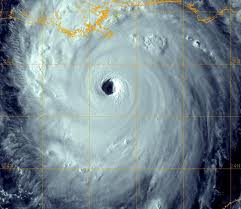
Hurricane Katrina
By mid-November of 2011, our three reading classes at the Loyola Intensive English Program (LIEP) had spent much time exploring Hurricane Katrina in a close and personal way. We had read the emotionally gripping Hurricane Katrina story of the Zeitoun family in the book ZEITOUN by Dave Eggers, we had seen the effects of the hurricane on a Saint Bernard Parish family in the documentary STILL WAITING, and we had heard personal Hurricane Katrina stories from three women who remained in New Orleans during and immediately after the hurricane.


Now it was time to step back and view a wider picture by using the lens of sociology. To do this, we invited Dr. Bethany L. Brown, Assistant Professor in the Department of Criminal Justice at Loyola University New Orleans, to speak with us. Dr. Brown's background in both sociology and criminal justice and her research focus on crisis and disaster situations made her the perfect person to help us widen our perspective on Hurricane Katrina.


Dr. Brown explained that sociology is a scientific and systematic study of human society that helps us to see general patterns. It enables us to see personal problems in light of larger social issues.  Sociology analyzes things that are often taken for granted and makes those things conscious and visible.


The sociology of disaster examines what happens when a hazardous event and people interact. Dr. Brown emphasized that a disaster does not create social problems but reveals problems that are already there.


One social problem brought into stark visibility by Hurricane Katrina is social inequality. Those with money, resources, and connections could evacuate if they chose to do so, while those without money, resources, and connections could not. No provision was made to assist those without money, resources, and connections other than the very inadequate Superdome and the utterly inadequate Convention Center. When people must rely on their own resources in a disaster, the unequal distribution of resources becomes highly visible.


Dr. Brown also called our attention to another social problem made visible by Hurricane Katrina--society's unequal treatment of people from different racial backgrounds. Dr. Brown illustrated this with two contrasting news photos. Both photos show people who retrieved food and supplies from convenience stores in New Orleans after Hurricane Katrina in order to survive. In the first photo, the people are African American (black), while in the second photo, the people are Caucasian (white). The two photos appear below, with the relevant words in each caption capitalized.


The first photo shows two African American women carrying bags through the flood.
"LOOTERS carry bags of groceries through floodwaters after TAKING the merchandise AWAY
from a wind damaged convenience store in New Orleans"


The second photo shows two Caucasian men also carrying bags through the flood.
"Two RESIDENTS wade through chest-deep water after FINDING bread and soda
from a local convenience store in New Orleans"


The African American women are described as LOOTERS who TAKE groceries AWAY. The Causasian men are described as RESIDENTS who FIND groceries. Although both the African American women and the Caucasian men were doing the same action (retrieving food and drink from a convenience store) for the same purpose (to survive), the African Americans are pictured as thieves and the Caucasians as survivors.


Dr. Brown helped us to see the larger social issues underlying the personal Hurricane Katrina stories we had read and heard. Thank you, Dr. Brown, for helping us to widen our lens and view Hurricane Katrina from a sociological perspective.


Our next post will tell you about our van tour of New Orleans sites important in the book ZEITOUN by Dave Eggers, read by LIEP students in our reading classes. We visited the sites important to Mr. Zeitoun and his family as they struggled through the difficult time after Hurricane Katrina.